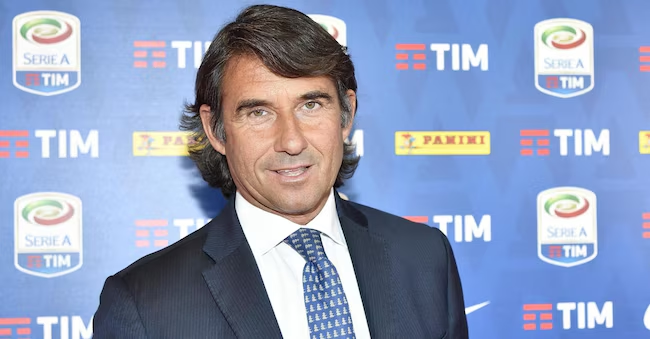


The long-running saga of Juventus’s Financial Fair Play breach with UEFA is approaching its conclusion. According to Corriere dello Sport, an agreement has effectively been reached between the two parties — only the final formal steps remain before UEFA makes the settlement official. The terms are considerably less punishing than some had feared, and crucially, they align comfortably with the financial strategy already being pursued by new chief executive Giovanni Carnevali.
The Fine: Less Than €7 Million
The financial penalty will be contained. The fine for Juventus’s breach of UEFA’s Financial Fair Play regulations over the 2022-25 period will not exceed €10 million — and is likely to come in at between €6 and €7 million. For a club of Juventus’s scale, and given the severity of the losses posted in recent years, that represents a relatively manageable sanction.
The Real Constraint: Transfer Balance for the Europa League
The more operationally significant element of the settlement is the “transfer balance” requirement attached to Juventus’s Europa League squad registration. In practice, this means the total cost of the Europa League squad submitted at the end of August must be no greater than the cost of the squad that Juventus registered for the Champions League last February — specifically the list submitted for the last-16 play-off double-header against Galatasaray.
The calculation is not simply a headcount exercise. It encompasses the full financial footprint of each player — transfer fee amortisation plus wages — creating an effective cost ceiling for the squad. Incoming signings must be offset by outgoings of equivalent or greater total financial value. As Damien Comolli explained at the time the requirement was first discussed: “The European squad will need to have the same cost as the one presented in February for the Champions League.”
How This Affects Juventus’s Summer Business
The February squad list included 23 players in UEFA’s List A, alongside Kenan Yildiz, Gil, Scaglia, and Fuscaldo in List B as homegrown products. Among those registered were players now almost certain to depart — including Vlahović, Filip Kostić, Juan Cabal, Lois Openda, Jonathan David, Michele Di Gregorio, Mattia Perin, and Leandro Zhegrova. The departures of these players, and the wage savings that accompany them, will free up considerable financial space for incoming acquisitions.
The final reckoning will come at the end of August, when the total cost of the Europa League squad is calculated. If the numbers do not balance, Juventus would have the option of dropping one or two squad places to bring the figures into line — but the club are confident this will not be necessary. The direction of travel under Carnevali — reducing the wage bill by between 10 and 15 per cent whilst bringing in younger, lower-cost profiles — is entirely consistent with what UEFA’s settlement requires.
A Framework That Suits Carnevali’s Approach
Far from being a burden, the settlement agreement effectively formalises what Carnevali was always going to do anyway: sell the expensive underperformers, reduce wage commitments, and build a leaner, more sustainable squad. The UEFA framework and the new chief executive’s business philosophy are, in this respect, pulling in exactly the same direction. When the formal announcement arrives — expected before the end of next week — it will mark not just the end of a difficult chapter, but the formal beginning of the new one.