

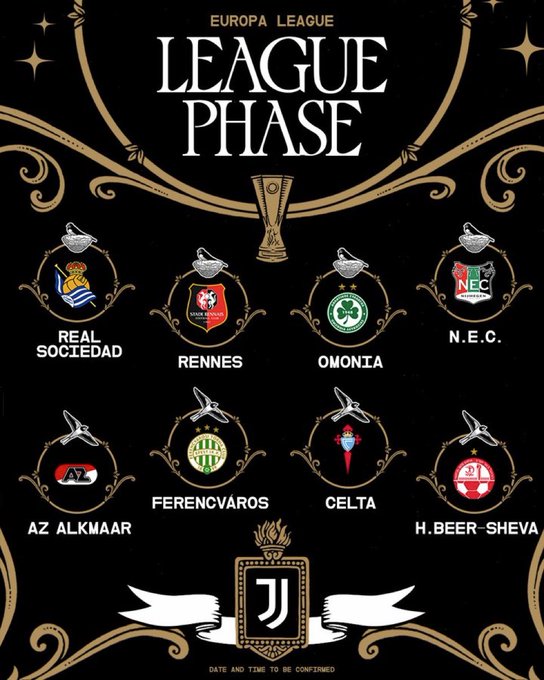
Good start, Juventus. And let it be genuinely good. Because the Europa League is not to be underestimated — and there is almost no space this season for testing, experimenting, or finding out. The squad is already too thin. The atmosphere at the Continassa is already too heavy after Sunday’s Sassuolo defeat. And there is serious money at stake.
The Prize Fund — €565 Million to Distribute
The Europa League’s total prize fund for 2026-27 is €565 million — distributed across 36 participating clubs in a multi-component structure that rewards every victory and punishes every defeat with compounding financial consequences.
The largest single element — 27.5% of the total, or €155 million — is allocated to participation: a fixed starting payment for every club in the competition, distributed equally. A further 37.5% — €212 million — is assigned based entirely on performance: what you win, and how far you go. The remaining 35% — €198 million — is the Value Pillar, the mechanism that replaced the old market pool and historical ranking system, distributing funds based on a combination of national broadcasting importance and UEFA’s five-year and ten-year historical rankings.
The Per-Match Payments — Every Result Has a Price
The granular payment structure is deliberately and powerfully meritocratic. Each Europa League group-phase victory is worth €450,000. A draw earns €150,000. At the end of the eight matchdays, the overall standings determine further prizes: the club finishing 36th and last in the group table collects €75,000 in ranking bonuses; the club finishing first collects €2.7 million. Between those two extremes, every position carries its own specific premium.
The top-eight automatic qualifiers for the last 16 also receive an additional €600,000 bonus. Clubs finishing ninth to sixteenth — who enter the playoff round — receive €300,000, with a further €300,000 for progressing through the playoff.
What Juventus Are Already Guaranteed
For Juventus and Milan specifically, the calculation of minimum guaranteed income — combining participation fee, ranking position, European market share, and Value Pillar allocation — produces a floor of approximately €14.4 million for the bianconeri and €13.5 million for the rossoneri. This is income they receive regardless of results, simply by virtue of participating.
That €14.4 million is still approximately €32 million short of the €47 million that Champions League participation would have generated — the most vivid single number illustrating the sporting and financial cost of last season’s fifth-place finish.
What Victory Would Be Worth — and Why It Almost Covers the Past
The knockout-stage prizes escalate with each round: €1.75 million per round-of-16 match won, €2.5 million for each quarter-final victory, €4.2 million for semi-final qualification. Reaching the final is worth €7 million; winning the trophy adds a further €6 million. In total, a club that wins the Europa League receives approximately €21 million in knockout-stage prize money — added to the €14.4 million already guaranteed, the total reaches approximately €35 million.
Corbo’s closing observation is the one that will resonate most at the Continassa: €35 million would, in round terms, cover the financial damage of recent transfer mistakes. The equation is brutal but clarifying. Win this competition — or go as far as possible within it — and the books look considerably better. Lose early, and the gap between Europa League reality and Champions League ambition becomes an open wound in the balance sheet as well as the sporting one. Thursday begins the calculation.