
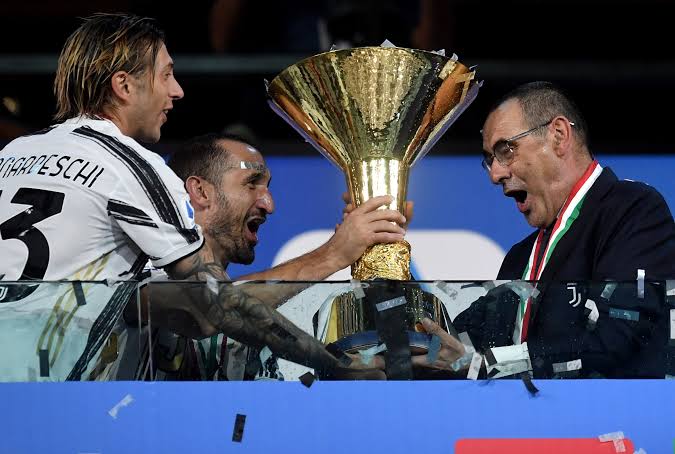
Maurizio Sarri returns to the Allianz Stadium on Sunday with Atalanta — the ground where in 2020 he won his only Scudetto, and the last time Juventus lifted the title. The occasion carries an obvious narrative weight, and Sarri has characteristically declined to soften the edges of it. Speaking to Sky Sport Insider, the Neapolitan manager addressed his new life in Bergamo, his career analogies, his approach to the transfer market, and — with a directness that will generate reaction in Turin — his honest assessment of his single Juventus season.
“No Great Memories — and No Regrets”
The passage that will most inflame the build-up is delivered with the clipped honesty Sarri has made his conversational signature. “Do I regret having managed them for only one year? It was a strange season — with the stadiums practically empty from March onwards. And perhaps for that reason too, I don’t have great memories of that experience. In any case, no regrets.”
Tuttosport’s editorial observation is pointed: that having no great memories of a season managed with a front three of Ronaldo, Dybala, and Higuaín — alongside the arrivals of De Ligt, Romero, and Demiral and the return of Buffon — does jar somewhat. The love affair with the Juventus fanbase never ignited, confirmed by the early Champions League elimination against Lyon, and the cup and Super Cup defeats despite having a squad that, on paper, should have achieved considerably more.
“The Most Similar Experience Was Empoli — After Nine Matches We Were Last. Then We Made the Playoff Final”
On Atalanta’s difficult start to the season and the historical pattern of slow beginnings at every club he has managed, Sarri was entirely untroubled. “With several of my previous experiences there are analogies — with some no, with others certainly yes. The most similar was Empoli: after nine fixtures we were bottom of the table, and we then made the playoff final. At Napoli after four matches we had two or three points. These difficulties have come out constantly throughout my career. The only experience where the initial phase was positive in terms of results was at Chelsea. For the rest, it has always been difficult — and the reason is obvious: the more completely different the previous style of play was from mine, the greater the difficulty at the start. This is a year of construction.”
“No Manager Is Ever 100% Happy with the Market”
On Atalanta’s transfer activity and the inevitable question of whether the squad fully reflects his requirements, Sarri was simultaneously generous and realistic. “A manager who is completely happy with his club’s transfer market — I have yet to meet one in my entire career. The evaluation must be made as a whole, not on individual arrivals. Important players have arrived, some still developing, some already formed and ready. Overall players of value have come — and that is what counts.”
“The Formation Is an Hypothesis — What Counts Is How You Defend and How You Attack”
The philosophical passage that defines Sarri’s coaching identity was delivered with characteristic brevity: “The formation leaves the time it finds — it is one hypothesis among many. What truly counts is the way of defending and the idea for attacking. The way the squad moves and reasons collectively. The formation can have its importance, of course — but it is not the decisive factor in determining the level of a squad.”
It is, in the week of Spalletti’s own tactical shift to the 3-4-2-1 for the NEC match, the most pointed possible rejoinder from the opposing bench — a reminder that tactical flexibility, whilst useful, is secondary to collective identity and shared understanding. Sunday’s match provides the opportunity for both managers to demonstrate which has built theirs more effectively.