
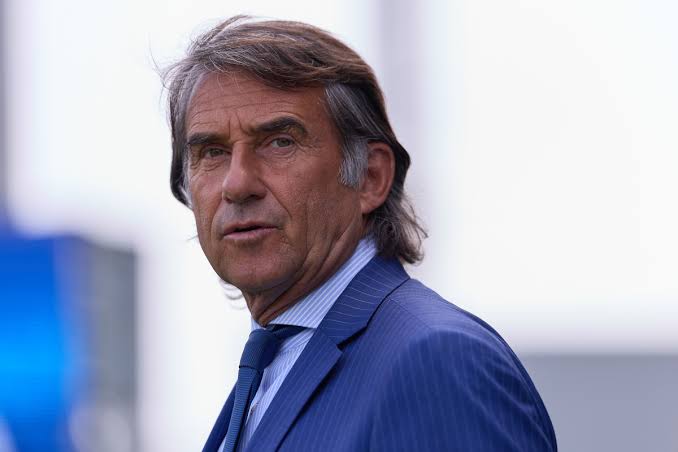
A good corporate director is judged over the medium to long term — three to five years. But in politics, the first hundred days of a government are considered the fundamental initial verification of whether an executive’s work is sound. Giovanni Carnevali is neither a head of state nor a minister, but today he marks exactly one hundred days at Juventus since he took up his position at the Continassa on 15 June. Tuttosport’s assessment — delivered across three of the paper’s most authoritative voices — is detailed, balanced, and honest about both what has been achieved and what lies ahead.
What Carnevali Found — the Comolli Disaster in Full
The starting point of any honest assessment is the inheritance. Damien Comolli spent one year at Juventus without leaving an identifiable mark or earning John Elkann’s confidence. He departed having committed the club to a squad bloated with expensive underperformers, a dressing room without clear identity, and a UEFA Settlement Agreement that demanded immediate and precise financial management. Carnevali arrived to fix a situation requiring complete reconstruction — not management or continuity, but renovation from the foundations.
His first decision — one that defines everything that followed — was to keep Spalletti and build around him. The manager was not Carnevali’s personal choice, having been appointed under the previous administration. But the shared vision and the institutional trust that Carnevali immediately invested in the relationship made him feel like his own appointment. The personal chemistry between the two men has been one of the period’s most important and least publicly discussed assets.
The Italian Paradox — Italian Leadership, Foreign Squad
One of the more striking dimensions of the hundred days is a structural tension that Tuttosport identifies with characteristic directness: Juventus now have their most Italian-flavoured leadership structure in many years — Carnevali, Massara, Ottolini, Chiellini — whilst simultaneously fielding what is historically one of their least Italian squads. Ten foreign outfield starters against Atalanta, with Vicario the only Italian. The paradox is real, acknowledged, and identified as an area where the work of the next thousand days must produce visible change.
The Transfer Market — Done Under an Impossible Constraint, Not a Comfortable One
The summer’s market is assessed as an achievement in adverse conditions rather than an ideal exercise in unconstrained ambition. The Settlement Agreement imposes strict squad-cost ceilings and detailed reporting obligations to UEFA on every market transaction. The cost of incoming signings cannot exceed the cost of outgoing ones. Within those constraints, Carnevali and Massara produced nine new arrivals, cleared an overloaded squad, and delivered a competitive group — albeit one that has since been devastated by injuries that no summer planning could have anticipated.
The financial arithmetic is precise and demanding. Juventus’s allowed deficit for the current financial year stands at €5 million maximum. By next year they must break even. From 2028, the standard Football Earnings Rule applies — provided the wage ratio to revenue stays below 70% in 2026. Every euro spent, every contract signed, every loan fee agreed has been subjected to this forensic discipline.
Ravanelli’s Endorsement — and His One Clear Demand
Fabrizio Ravanelli has emerged as one of the period’s most consistently engaged external voices, and his assessment of Carnevali is warm and specific. “He arrived at Juventus quietly, transferring his leadership through work. I am convinced he is the right man to put this club back on track — provided he is left to work in peace without external pressure.”
His specific enthusiasm for Sarr — “I like him enormously, he has legs and physicality and I believe he will be one of the most interesting surprises of the season” — is the endorsement that will please Spalletti most. His demand, however, is unambiguous: “I expect Carnevali to transform this squad by adding an Italian identity, a solid Italian core. The history of the club says it: there is no winning Juventus without great Italian players.”
And his prediction on the timeline: “If this management remains in place, Juventus will win the Scudetto again within two or at most three years. The foundations are good — Lucumí, Bremer, and Kalulu have sorted the defence; Yıldız, Alajbegovic, and Kolo make you competitive up front. A few more pieces are missing, but I am certain they are coming.”
The Scouting Rebuild — Identifying the Next Yıldız
The area Carnevali has identified as the most urgent structural rebuild — beyond the immediate squad — is scouting. The department was largely dismantled during the Giuntoli-Comolli succession, and rebuilding it is identified as one of the primary objectives of the next year. Two names are most prominently associated with the incoming scouting structure: Enrico Paresce, who worked alongside Massara at Roma and Rennes, and Davide Cangini, Carnevali’s most trusted scouting figure from his Sassuolo years. Their arrival would give the department the experienced, relationship-driven foundation it currently lacks.
The stated objective behind this reconstruction is the one that most clearly captures Carnevali’s philosophy: finding the next Yıldız, the next Huijsen, the next Soulé and Barrenechea at early enough ages to develop them within the system, at prices compatible with the financial constraints, rather than competing for established players at market rates that the Settlement Agreement makes impossible.
The New Stadium — a 5,000-Seat Ground for the Next Gen and Women
The broader structural ambitions include one project that has been discussed for years without materialising: a dedicated stadium of approximately 5,000 seats for the Next Gen and Women’s teams, planned for a site adjacent to the Continassa training complex. With careful, long-term financial management — the kind that Carnevali has consistently delivered throughout his career — this project moves from aspiration to possibility. It is one element of a broader infrastructure vision that positions the Continassa as the institutional heart of a club genuinely building for the future.
The Exor Impact — 232 Million Euro Hit from Juventus Shares
The most sobering financial note in Tuttosport’s assessment concerns Exor’s half-year results to 30 June 2026. The Agnelli-Elkann family holding company reported a consolidated loss of €1.122 billion for the period — with €232 million of that figure directly attributable to the decline in the market value of Juventus shares. The club’s shares had been valued at €789 million in Exor’s books at the end of 2025. By 30 June 2026, that figure had fallen to €557 million. The drop reflects the market’s assessment of a club in transition, not generating Champions League revenue, and carrying significant financial obligations. It is a reminder that the hundred days, however productive they have been in sporting and operational terms, sit within a financial context of considerable gravity. The next thousand days must produce results — on the pitch and in the accounts — that begin to reverse that trajectory.