
The night on the Via Emilia has had one unmistakable effect above all others: it has stripped away the protective cushion of goodwill and patience that surrounded Luciano Spalletti’s project at Juventus. On the morning after Reggio Emilia, the club is held up to the mirror — and the mirror says that the version of the Signora seen on Sunday evening must never be allowed to find its way onto a pitch again.
The mood at the Continassa is contained in the manner in which the match slipped away: a first half played without enthusiasm or conviction, an attempted resurrection conducted with ten men charging forward without structure, and the final affront — a young former Juventus loanee apologising as he buried the decisive goal that put a whole travelling party under examination.
No More Alibis — When Your Own People Fail You
The injury list and accumulated misfortune matter — they cannot not matter. But when the defeat is stained by the failures of the manager’s most trusted players — the ones who should know better, who carry more experience than anyone around them — the case becomes considerably more serious. Bremer, captaining the side for the first time after Locatelli’s surgery, produced his worst performance since arriving at the club. Kalulu moved like someone running with two gears locked out — unrecognisable from the player who accumulated more minutes than any other last season. Lucumí, signed precisely for his ability to carry the ball from defence, found the ball burning his feet so painfully that he was on the bench by half-time. In midfield, the passing was predictable. On the flanks, clarity belonged to Zhegrova alone — and only once the match was already lost. Kolo Muani gives no signals. Woltemade gives some — but not the ones requested.
Spalletti’s response to the group on Monday morning was direct and unambiguous: find enthusiasm, find courage, find the willingness to attempt the less predictable, less conventional choice. These are the commandments the manager has delivered to his players — and these are what the club expects from a manager who signed a contract extension in April running until June 2028.
The Numbers That Are Making Things Uncomfortable
The statistics that context demands: Spalletti’s points-per-match average since last November is lower than those of the managers considered his most serious domestic rivals — Chivu, Fàbregas, Gasperini. Carnevali’s public statement, delivered on Radio Anch’io Sport, carried a warning more pointed than its careful phrasing acknowledged: “It is not in my spirit to change the manager… but the defeat at Reggio Emilia must serve as a lesson.” Translated: Spalletti is not at risk. But he could become so if he cannot eliminate, rapidly, the confusion and collective disorientation that turned Sunday’s match into an inexplicable disaster.
Five points separating Juventus from the Serie A summit after only three weeks of football. A market that was imperfect but not trivial — Lucumí and Kolo Muani were explicitly and forcefully requested by the manager himself, and between them, Alajbegovic, and the goalkeepers, approximately €100 million was invested this summer. When Adžić finds a clear run and the penalty area presents itself at the 94th minute, those who are in the treatment room cannot be called in evidence to explain the catastrophic defeat.
The Conte Faction — Growing, Watching, Waiting
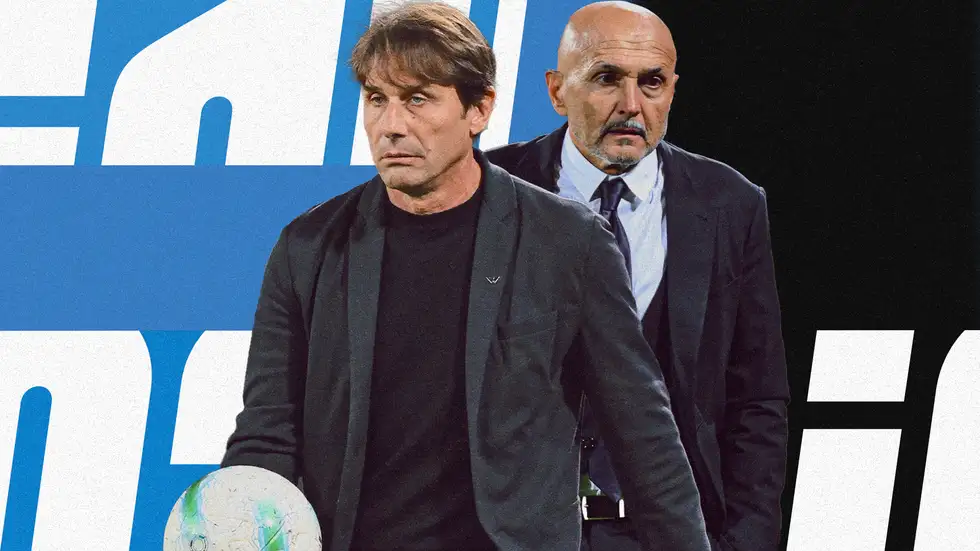
And in this context, in the stands and on social media, the faction dreaming of Antonio Conte’s return is growing louder. Conte is free. He is in the city. He is watching football attentively, annotating, observing — a man who considered the Italy job for a brief moment, who thinks about returning with a defined project, but for whom “his” Juventus would represent the one exception to every condition and every reservation he might set. An exception not as a burden but as the natural conclusion of a story that is, in some sense, always unfinished.
Carnevali does not change managers by instinct or character. But the law, as always in football, is written in results — and in attitude. Enthusiasm and courage, right now, have not been seen. The Europa League opener against NEC Nijmegen on Thursday provides the first opportunity to demonstrate they exist. Atalanta away, the following week, is the test that will determine whether Sunday’s collapse can be consigned to the archive as an aberration — or whether the question surrounding Spalletti becomes, as Gazzetta puts it, considerably more pressing.