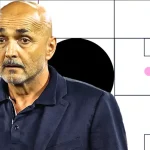


Spalletti has recovered the best Douglas Luiz. He has pulled back the most luminous version of Nico González from the edge of institutional irrelevance. There is, however — for the manager of Certaldo — one mystery still unsolved: Teun Koopmeiners. His highs and lows are worth analysing for their capacity to confound. He comes on in the final minutes at Frosinone and ends up attracting the opposition’s fury, with Alvini’s team sucking the Juventus midfield back and nearly equalising through Calvani — denied only by the crossbar. He comes on against Parma and scores from his very first touch. He leaves his imprint against Milan with the exquisitely weighted assist for Gatti’s header. At Reggio Emilia the chance to start from the beginning arrives — and it is wasted badly. He closes without incident against Atalanta, when the final minutes Spalletti grants him allow him to slot into the rhythm of a lead already being managed.
The Serbia Goal — Xavi Finds What Spalletti Has Been Looking For
The news that Koopmeiners returns to the Continassa in genuinely good spirits is itself a change in the article’s atmospheric tone from what has gone before. He is galvanised — not merely by the goal scored from a free kick against Serbia, but by the way in which he handled the unexpected and entirely unfamiliar opportunity that Xavi gave him: starting as a central defender in the Netherlands’ three-man back line.
This is the Pirisi observation that carries most weight in the context of everything that has been discussed in this session. Koopmeiners, deployed in a position outside his natural range at club level, played intelligently, composedly, and without the inhibitions that have seemed to seize him whenever the responsibility of a central midfield role has been placed on him at Juventus. He did what Spalletti has been waiting for him to do at the Continassa — and he did it in the Netherlands shirt, at centre-back, under Xavi.
Spalletti’s Patient Management — and What the International Break May Have Changed
The second chapter — “Spalletti e la gestione di Koop” — addresses the manager’s approach to a player whose continued presence in the squad is conditional on visible improvement, and whose three consecutive bench appearances before the break represented the clearest possible institutional signal that patience has limits.
What the break has potentially provided is a psychological recharge that the Juventus training environment has been unable to generate. A player who has been struggling at his club — whose confidence has been depleted by a sequence of unsatisfactory performances in an environment that has never quite felt like his own — sometimes needs the specific, uncomplicated affirmation of performing well for his national team to rediscover the self-belief that was the foundation of everything good he produced at Atalanta.
“I Often Play in Very Different Positions, but…”
The third chapter carries a headline drawn from Koopmeiners’s own words during the international break — a public admission that playing in multiple different roles in the Netherlands setup and in his attempts to establish himself at Juventus has created its own form of dislocation. The sentence trails off, but its implication is clear: the player himself is aware of the problem, and is articulating something about the need for a defined identity within the system.
Whether Spalletti can provide that identity — whether the return to the Continassa galvanised by the Serbia free kick and the Xavi central defensive experiment translates into the consistent, dominant, match-changing performances that Atalanta supporters remember so vividly — is the central question of the next three months. The three-month clock that Gazzetta set ticking is still running. The international break may have extended his terms by a fortnight. The rest depends on what he produces from Sunday at Cagliari onwards.