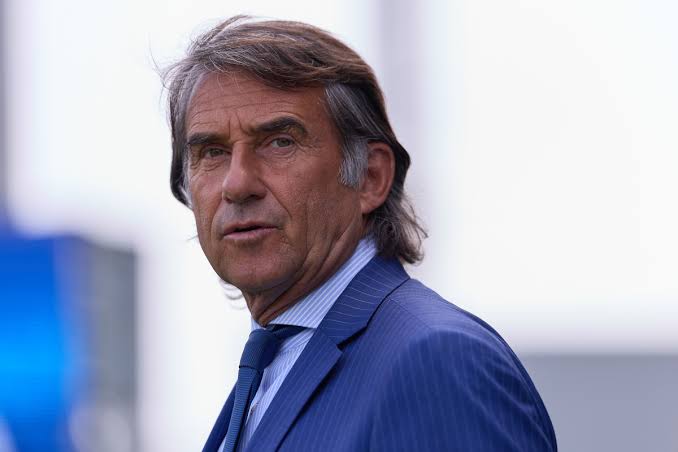


Former Juventus and Milan defender Nicola Legrottaglie has opened up about the most defining moments of his career and life beyond football — from his faith and his bond with Zlatan Ibrahimović, to his frightening injury at San Siro and the unforgettable dressing‑room stories involving Antonio Cassano.
In recent years, Legrottaglie has reinvented himself as a coach and technical director, notably spending five years on various benches and later joining Sampdoria’s management. He has written several books, including “12 in campo”, and appeared as a pundit on television. Yet, as he admits, breaking through on screen has not been easy.
“In Italy, they often prefer to give space to foreigners who may not even speak the language well, instead of those who can communicate naturally with the public,” he observed.
“The Call That Changed My Life”
Legrottaglie described his religious conversion as the defining call of his existence. “The call that changed my life? The one I felt in my heart — it was my conversion, God’s call. It came with no number or area code; it came from above. It was the most beautiful call,” he said. “Then, on a human level, the call from the national team was another immense joy.”
He says he was “reborn” in 2006, at the age of 29, when he chose to be baptised again.
Ibrahimović: “Jesus Won’t Win You Titles. I Will.”
Among the many anecdotes, Legrottaglie recalled a conversation with Zlatan Ibrahimović from their time together at Milan. “Once, Ibrahimović said to me: *‘Nicola, Jesus doesn’t win you championships. I do.’* It was a joke, his way of teasing,” he said. “He was always funny, and we shared some truly great moments. By then my image as a man of faith was well known in football, but it never bothered me. I’d rather be labelled as someone who speaks about Jesus than as someone who doesn’t respect values.”
Legrottaglie offered a glimpse of Ibrahimović’s more human side. “Explaining Ibra isn’t easy — you need to see him live. We all wear masks to protect ourselves from past wounds or hidden fragilities. When Ibra acts like a commander, he’s also covering up his weaknesses. I got to know them over time, and that’s the beautiful part. What I’ll never forget is seeing him at Milanello after training, playing with his children — affectionate, sweet, present. That’s the real Ibra. With teammates, he was tougher. When you made mistakes, he wouldn’t let you off, but he did it to push you. It worked for some, not for others.”
“Wearing the Juventus Shirt Feels Heavy”
Reflecting on his time in Turin, Legrottaglie described the unparalleled weight of wearing the Juventus badge. “How heavy is the Juventus shirt? Many kilos — it represents an entire people. Wherever you go, you find Juventus fans; you feel their passion. The moment I left the club offices after signing with the Triade, my life changed. People recognised me everywhere, even abroad. That’s when I realised how much history and responsibility that shirt carries.”
He also spoke fondly of his former teammates. “With Chiellini I got along perfectly. We were opposites — the holy water and the fire,” he smiled. “But that’s why we complemented each other. Montero was another world — extroverted, unpredictable, yet a true leader. Sharing a dressing room with Buffon, Del Piero, Nedvěd and Camoranesi reminded me that behind every champion there’s a person. In that Juventus, even players like Tacchinardi, Birindelli, and Pessotto were essential — they made the whole team function.”
“That Juventus in Serie B Built the Next Nine Titles”
On the turbulent Calciopoli years, Legrottaglie made it clear he sees continuity between the Juventus side relegated to Serie B and the one that later dominated Italian football. “We laid the foundations. That wounded but alive Juventus created the culture of rebirth,” he said.
“The game is cyclical: you win for nine years, then you stop. Identity is what remains even when you don’t win. Juventus are always winners — even when they finish third, even when they’re relegated — because a winning identity doesn’t depend on results, but on who you are.”
Coaches and Lessons Learned
Legrottaglie also reflected on the array of managers he worked with. “Delneri was innovative — he taught me things no one ever had. Ranieri was balanced — when he’s gone, you feel his absence. Deschamps said little but saw everything. Zaccheroni was one of the kindest men I’ve met — almost paternal, like Ancelotti, though I never played for him. Ciro Ferrara was a friend — maybe not yet ready as a coach, but a man of great humanity. Montella and I helped each other — he had forward‑thinking ideas, and we played great football. Allegri? He’s cheerful, a real people person. He knows how to joke, motivate and ease the tension — few manage champions like he does.”
Cassano and the Saints
Legrottaglie laughed as he recalled the ever‑colourful Antonio Cassano. “Cassano has always been a character, always entertaining. I’ll never forget a Juventus–Sampdoria match. After the game he came up and said in dialect: *‘Mate, give me your shirt, the only one I want — I’ll have the saints and the Madonna pray over it.’* I laughed and gave it to him for his mother.”
Another story came from his early days at Milan. “On my first day, there was chaos in the shower with all the Brazilians, talking about faith and religion. Cassano teased me after reading one of my interviews, and I replied. Suddenly all the Brazilians, who were believers, took my side against him — it turned into a full‑on debate! People came in to see what was happening. It was lively and hilarious.”
“I Was Paralysed on the Pitch”
One of the most dramatic moments of Legrottaglie’s life came in February 2011, during Milan–Lazio.
“I had a bad fall after a collision with Kozák,” he recalled. “I’d started playing really well, and I’m convinced if I’d continued, my Milan spell would’ve gone differently. When I fell and opened my eyes, the first thought was fear: I couldn’t move — I was paralysed. My arms and legs went their own way; I had no control. When I saw the doctor’s face turn white, I got even more frightened. He asked, ‘Can you move?’ and I said, ‘No.’ That’s when I realised it was serious.”
But his faith steadied him. “Inside, I felt calm. I thought: *‘What I’m seeing won’t happen — what’s been promised will.’* I found strength. Four minutes later, on the way to hospital, I began to feel tingling. I thanked God. But I still have a scar on my spinal cord — an actual lesion I only discovered three years later.”
“Even now, when I see similar scenes, I think the same thing: *‘How did I try to head a ball that was a metre off the ground?’* I bent down to nod it back to my midfielder, when he arrived running and hit me with his knee. My neck snapped back — that’s when I got hurt. Kozák apologised immediately on the pitch. We never spoke again afterwards.”