

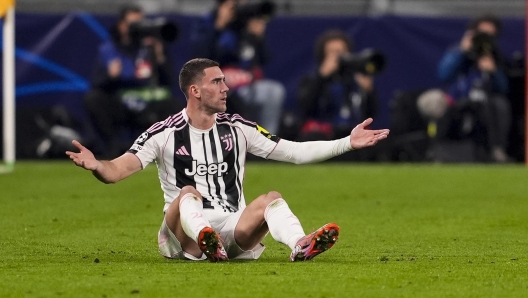
Gianluca Rocchi, the head of Italy’s referees, has backed the decision to overturn the penalty initially awarded to Dusan Vlahovic during the recent Fiorentina-Juventus match, describing the intervention by the VAR team as “excellent work.”
Juventus are currently in Bodø for their crucial Champions League fixture this evening, a match that could prove decisive for their European campaign. Luciano Spalletti’s side are aiming to bounce back from their disappointing display in Florence, a performance Andrea Cambiaso himself defined as “below par” on the eve of the game.
During the Fiorentina match, one of the most debated moments came when referee Daniele Doveri initially awarded a penalty for a coming together between Vlahovic and Pablo Marí. After consulting VAR and reviewing the incident at the monitor, Doveri reversed his decision, instead awarding a free kick to Fiorentina for an earlier foul by the Serbian forward.
During DAZN’s Open Var programme, Rocchi offered his assessment of the episode (as quoted by IlBianconero).
“The initial call was a penalty, and I would have made the same choice in real time,” Rocchi explained. “However, on closer analysis, as the VAR correctly did, it becomes clear that Vlahovic first holds the Fiorentina defender and pulls him down. Doveri saw only the final part of the action. In my view, the VAR worked very well — the final decision was correct.”
Rocchi also praised the calm approach shown by Doveri during the on-field review. “I appreciated his composure in front of the monitor. Pablo Marí’s foul occurs later, but the first infringement is by Vlahovic, so the penalty could not stand.”
The refereeing chief went on to elaborate on the evolving role of VAR in modern football. “The VAR can intervene in any situation. We referees have adapted to the protocol, and our interpretation has evolved over time. One more on-field review is always better than one less — our aim is to reach the right decision. Every penalty we give must be 100% justified.”
Rocchi also rejected the idea of referees choosing to ignore uncertain incidents. “It worries me when I hear people say, ‘It’s better not to whistle at all.’ We can’t avoid making decisions — that’s part of our job,” he concluded.


