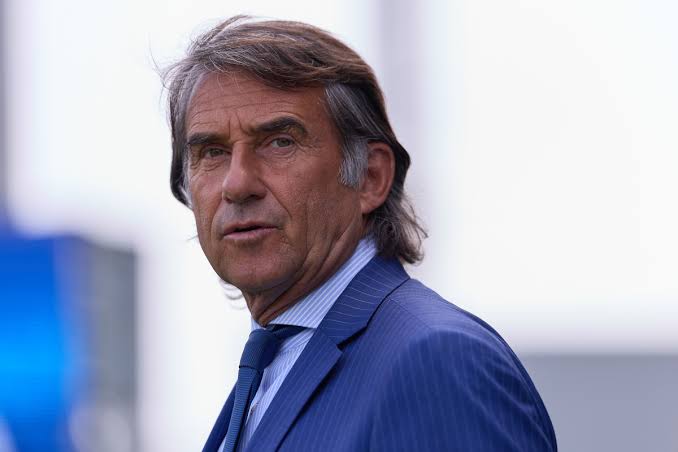


Tether CEO Paolo Ardoino has expressed a keen interest in contributing to Juventus’ future growth, suggesting the club can perform far better both on and off the pitch. Speaking to Swiss newspaper Il Corriere del Ticino (as quoted by Calcio e Finanza), Ardoino said he believes Juventus possesses “enormous untapped potential” and that Tether could play a key role in helping the club realise it.
Ardoino revealed that both he and Tether’s CFO Giancarlo Devasini are lifelong Juventus supporters. “Giancarlo and I are big fans of Juventus, but we also believe the club has huge unexpressed potential: 200 million fans around the world, many of them in emerging markets that we serve through Tether,” he explained. “We can help the club engage better with those fans and bring advanced technologies at the level of the biggest tech players – from artificial intelligence to performance analysis.”
The CEO, whose company operates one of the world’s largest stablecoins, repeated his conviction that Juventus could achieve far more with the right partnership. “We think Juventus can do much better, and we want to play a part in that improvement, even without taking full control of the club,” he reiterated.
Responding to ECB criticism of stablecoins
Ardoino also addressed warnings issued by the European Central Bank regarding the systemic risks of stablecoins. “The reason the ECB says these things needs to be examined from a scientific and economic point of view,” he said. “All European banks, and not only them, operate under the fractional reserve system: they are obliged to hold only about 10% of their assets in liquid form and lend out the remaining 90%. If I deposit €100,000 in a bank, €90,000 can be lent out. In Europe, deposits are guaranteed only up to €100,000.”
He argued that Tether’s model is far safer by comparison. “The ECB is concerned because stablecoins – and Tether in particular – work differently. We have about 80% in cash equivalents and a total deposit coverage that reaches 120%. When people start to ask why they should keep their money in banks, where in case of failure they recover only part of it, when they could use a fully backed instrument, it’s clear that, from the point of view of central banks, this becomes a systemic problem.”
“A bank that’s fully collateralised”
Asked whether Tether effectively operates like a bank that is fully covered by reserves, Ardoino replied: “Yes. With token technology, we achieve 100% – indeed more – in coverage. Today, out of roughly \$186 billion in deposits, we hold more than \$140 billion in short-term US Treasury bills, about \$15 billion in physical gold, and the rest in other cash-equivalent instruments such as Bitcoin. It’s a portfolio far safer than that of a traditional bank.”
He also highlighted Tether’s profitability model: “It’s possible to be a full-reserve bank and still generate profits. With \$186 billion managed at 4% per year, we’re talking about \$7–8 billion in annual profits without taking particular risks. We don’t need to lend customers’ money to keep the structure running, unlike traditional banks.”
Regulation, resilience, and transparency
Ardoino rejected claims that stablecoin issuers enjoy the privileges of banks without similar responsibilities. “That’s not true,” he insisted. “Unlike banks, we don’t have the privilege of keeping only 10% of our assets in liquid form. Regulations for stablecoins, such as the US GENIUS Act, are very strict. We can’t lend money, we can’t offer credit to buy a car, we don’t provide brokerage or investment management services. We issue, with full backing, a digital token equivalent to one US dollar. When the user wants to redeem it, they simply return the token and we give them back the dollar.”
Recalling the TerraLuna collapse in 2022, Ardoino pointed to Tether’s ability to withstand market pressure. “We went through a real bank run: \$7 billion repaid in 48 hours, and another \$25 billion over 20 days. No financial institution in the last 50 years has survived a 25% withdrawal of deposits. We did, because we had the reserves. We passed that stress test with full marks.”
He contrasted this with the instability of some traditional institutions. “The crises at Credit Suisse and the US regional banks that failed in March 2023 show that the old model isn’t risk-free,” he said. “Our model is a disruptive technological innovation – and it’s normal that it didn’t come from inside the banking system. It’s like expecting taxi drivers to have invented Uber. It’s unrealistic.”
lobal strategy and El Salvador base
Discussing Tether’s legal headquarters in El Salvador, Ardoino explained the reasoning: “European regulation is unworkable for us. It requires that 60% of reserves be held in uninsured bank deposits. Putting billions into banks insured only up to €100,000 makes no sense. The US framework that came into place this year is innovative, and El Salvador’s regulation is solid and aligned with the GENIUS Act.”
He underlined the company’s conservative reserve structure: “We use short-term US government bonds – the safest asset class. Even if Bitcoin were to fall to zero, we would still have more reserves than our obligations. We hold more gold than Bitcoin. Our gold is physical, not financial, and stored in Switzerland, audited quarterly. We also have around \$23 billion in retained earnings reinvested in the company. The structure is extremely sound.”