
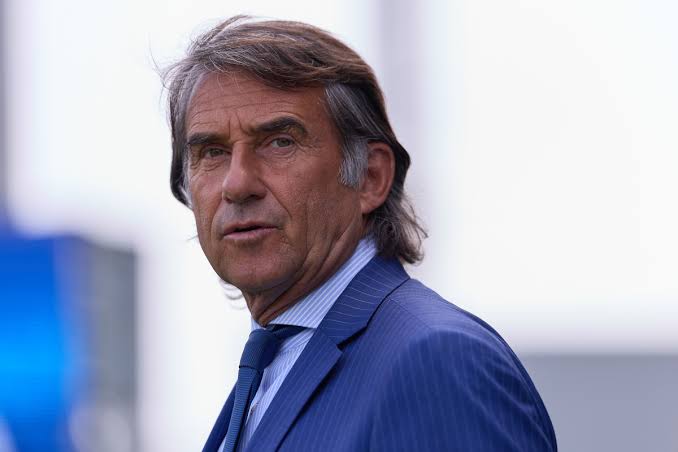
There is a shorthand for understanding how Giovanni Carnevali operates in the transfer market: buy at one, sell at two. It is a simplification, of course — but it is a simplification rooted in a remarkable body of evidence built across more than a decade at Sassuolo. Tuttosport report how his ten most profitable sales generated just over €265 million in total income. His ten most expensive purchases cost the club’s ownership barely €130 million — an average of €13 million per player. The delta is extraordinary, and it is precisely this kind of financial intelligence that Juventus have been sorely lacking in recent years.
The Scamacca Blueprint: Turning €500,000 into €40 Million
Perhaps the defining example of Carnevali’s method is Gianluca Scamacca. In 2017, Sassuolo spotted an opportunity to sign the striker from PSV Eindhoven — who had themselves taken him from Roma’s youth setup — for approximately €500,000. Five years later, he was sold to West Ham for nearly €40 million. It is a return that speaks not just to shrewd scouting but to patience, development, and an uncanny sense of timing.
Italian Talent at the Heart of His Model
While Carnevali’s biggest purchases were predominantly foreign players — seven of his ten most expensive signings were non-Italian — his greatest talent has always been identifying and developing homegrown talent. He paid €20 million for Andrea Pinamonti, around €15 million for Davide Frattesi, and €14 million for Manuel Locatelli. Every one of them was developed and sold at a significant profit.
The roll call of Italian players nurtured and sold at the right moment is remarkable: Scamacca, Locatelli, Frattesi, Giacomo Raspadori, Stefano Sensi, Matteo Politano, and Simone Zaza. Most were reintegrated into the Serie A ecosystem at precisely the right time and at precisely the right price.
The Art of Knowing When to Hold
What distinguishes Carnevali from many of his peers is not merely his ability to buy cheap and sell dear — it is his patience. The case of Kristian Thorstvedt illustrates this perfectly. When Sassuolo were relegated, most would have sold him. Carnevali held on. The Norwegian midfielder proved central to the club’s promotion back to Serie A, and under Fabio Grosso in the following season he developed into a genuinely valuable asset — having originally been signed from Genk for €10 million. He is now set to leave for considerably more.
Jérémy Boga tells a similar story: signed from Chelsea for €10 million, sold to Atalanta for €22 million. The pattern is consistent. Carnevali rarely panics, rarely oversells, and almost always identifies the optimal moment to act.
What This Means for Juventus
At a club that has spent recent years paying over the odds for underwhelming signings and accepting losses on players bought with high hopes, the arrival of a chief executive with this kind of commercial discipline represents a genuine shift. Before he is a football man, Carnevali is an entrepreneur — accustomed to mediating, negotiating, and coming out ahead.
The scale and pressure of Juventus is entirely different from anything he has managed before. But if the Sassuolo method can be applied — even partially — to one of Italian football’s greatest institutions, the implications for the club’s long-term financial health and competitive ambition could be transformative.