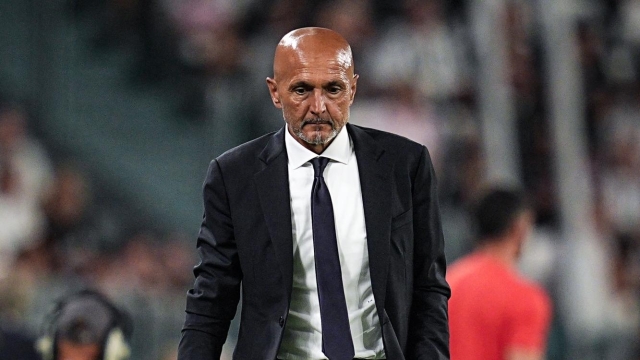


Juventus’s attacking future rests on the shoulders of two men who, between them, have played 510 professional matches and scored 145 club goals. Nick Woltemade — 177 appearances, 48 goals for his clubs, 12 caps and 4 goals for Germany. Randal Kolo Muani — 333 appearances, 97 goals for his clubs, 32 caps and 9 goals for France. Together, the German and the Frenchman will be tasked with making supporters forget about Dušan Vlahović — and with carrying Juventus back to the Champions League after last season’s painful absence.
The question is not simply whether they are good enough individually. It is whether, and how, they can operate simultaneously.
The Honest Admission — Neither Is the Classic Centre-Forward Spalletti Wanted
The article’s most important contribution is also its most candid: Calciomercato acknowledges plainly what Spalletti himself has effectively been saying since the Frosinone opener. Neither Woltemade nor Kolo Muani is precisely the profile the manager had in mind when he spoke of needing a “pure centre-forward capable of scoring 20 goals per season.” Both players love to roam across the entire attacking front, to link play, to contribute in areas beyond the penalty box. Both are, in the manager’s own terminology, nine-and-halves rather than nines.
Which is why Spalletti has been so publicly insistent that both men must adapt. On Woltemade: “Whether he wants to or not, he must become a finisher — he must be an offensive pivot.” The same implicit demand accompanied the Frosinone post-match strigliata directed at Kolo Muani. The manager is not unhappy with the players he has. He is demanding that they become, in addition to everything they already are, the penalty-box presence the system requires.
Formula One: One as Centre-Forward, One as Second Striker
The first and more immediately applicable co-existence scenario places one of the two as the central reference point and the other in the hole behind him — a number ten-and-a-half rather than a pure trequartista. Both would be flanked by wide attackers, maintaining Spalletti’s preferred 4-2-3-1 structure but with the creative depth of the number ten role filled by a forward rather than a technical playmaker.
This formula is viable both from kick-off and as a game-management tool — with the two players potentially alternating between the lead and supporting roles according to the match’s demands, defensive organisation of the opposition, and the game state. Woltemade, given his natural tendency to drop deeper and link, is perhaps the more natural occupant of the second-striker position.
Formula Two: The Double Centre-Forward — a Rescue Mission Only
The second scenario is considerably more radical and is explicitly described as a late-match emergency measure rather than a starting template. A 4-2-4 with Woltemade and Kolo Muani as twin forwards, flanked by two wide attackers and anchored by two central midfielders, provides maximum attacking firepower in the specific circumstance where Juventus need to overturn a deficit in the final phase of a match. It is the battering-ram option — a shift from structured attacking football to direct, high-volume, physical pressure in the area. In Spalletti’s system, it belongs to the closing minutes of difficult matches, not to the first whistle. But it is there, and it may yet prove decisive in one of the moments that defines the season.