
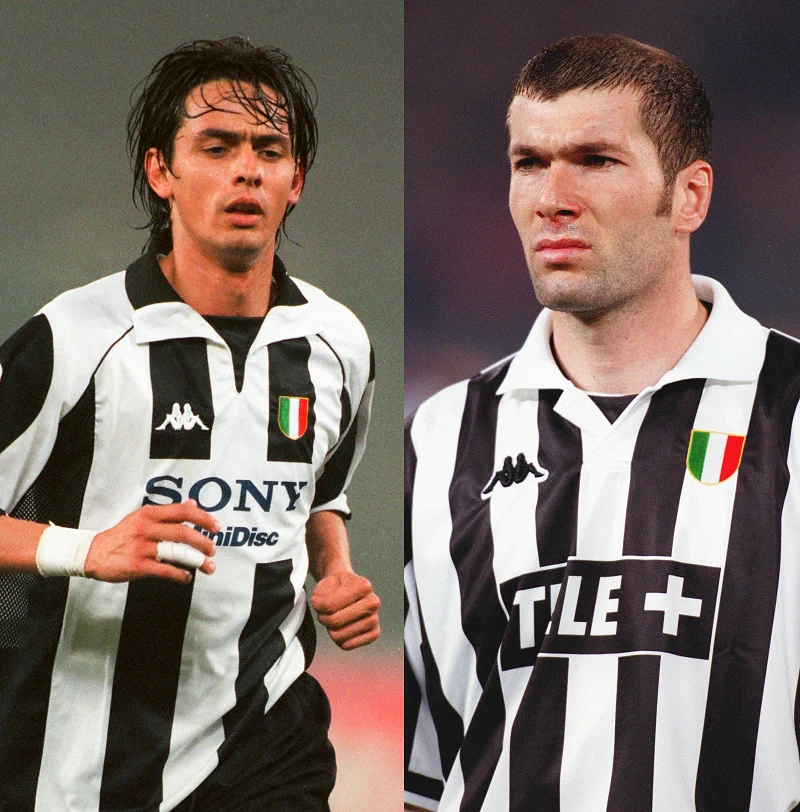
Paris, 20:45. France against Italy in the Nations League. Twenty years have passed since the most famous headbutt in football history — the moment that defined the 2006 World Cup final in Berlin and which, despite the twenty intervening years, still shapes how the two countries regard each other across a football pitch. Tonight the teams meet again. And on France’s touchline stands Zinedine Zidane himself — now national team manager rather than the player who dominated the second act of the Italian game’s greatest era. For Filippo Inzaghi, currently manager of Palermo, the evening carries a particular personal weight: four seasons at Juventus alongside Zidane, from 1997 to 2001, 137 matches shared, 13 goals scored by Inzaghi from passes laid on specifically by his French teammate.
“For an Attacker, Having Zizou Behind You Was a True Privilege”
“I can say I had the good fortune to play alongside someone like Zizou. For an attacker, knowing you had a teammate like that behind you was a genuine privilege.” The first observation captures the professional dimension of the partnership — but the second extends it into something more precise. “Zizou always knew how to put you in the best conditions on the pitch. He would see everything the moment you made the right movement — a ball, a run, and there was the intuition.”
The specific memory Inzaghi returns to is the Champions League quarter-final second leg in Kiev in 1998 — Juventus needing to win against Dynamo Kyiv after a 1-1 at home, and Zidane providing the assist for the first goal with one of those passes that, as Inzaghi puts it, only he was capable of delivering. “We came from a 1-1 draw in the first leg and needed to win there. On the first goal, Zidane put me in front of goal with one of those balls that only he could produce.”
“As a Manager He Has the Same Qualities — Intelligence, Personality, Reading the Game”
The success Zidane found as a Real Madrid manager — three successive Champions League titles — is explained by Inzaghi through the same analytical framework he applies to the player. “If you have that football intelligence, that personality, that capacity to understand the moments of a match as a player — you take it with you. It doesn’t disappear when you hang up your boots. If you have it, you carry it into whatever you do next.” The implicit comparison with Inzaghi’s own managerial career — building at Palermo after long stints in the lower divisions — is left unspoken but present.
“Zidane at Juventus — and Tonight Against Italy”
The occasion of the interview is of course tonight’s match, and both Inzaghi and the Gazzetta are drawn inevitably to the symmetry of it: Mancini’s new Italy, attempting to build something credible after three successive World Cup absences, facing the France of Zidane — a manager who knows Italian football from the inside, who matured at Juventus, and who understands precisely what the Italian national team can produce when it is desperate and well-organised.
Zidane himself, in a separate pre-match press conference reported by Tuttosport, addressed the symmetry directly. “At Juventus I grew up. Italy? It’s not the same as before — there are cycles — but this is a complicated team to play against.” On the three missed World Cups: “It’s something incredible, it belongs to football history, and it was strange. But Italian teams have always been capable in a single match of doing incredible things. That’s why I say it will be a complicated match to play.”
On the most famous moment in the history of France-Italy encounters — the headbutt in the 2006 final: “Non-beautiful things happen to everyone in life — but now we go forward and think about what happens tomorrow with the national team. That is what I focus on today.” The headbutt that gave Inzaghi’s former teammates the World Cup. The manager who carries its memory lightly, focusing instead on what happens tonight. The Gazzetta’s front page says it all: “Zizou, Again You.”