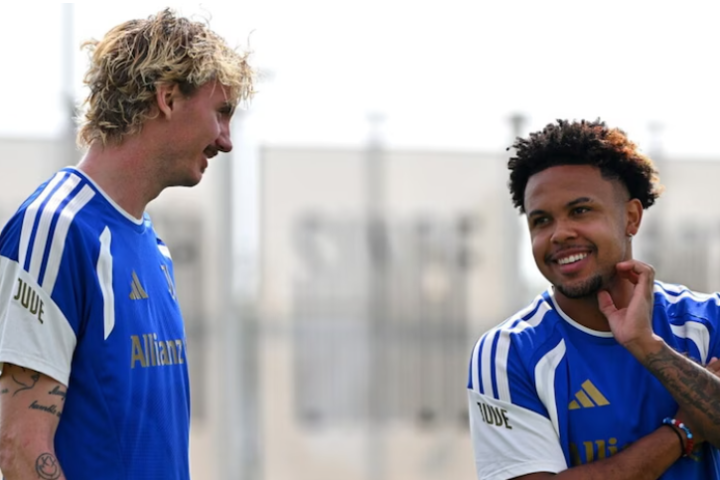


Weston McKennie has described his spell at Juventus as “an emotional rollercoaster”, lifting the lid on his journey in Turin during an appearance on the podcast The Cooligans. The American midfielder spoke candidly about belonging, criticism, growth and his determination to fight for his place at the club.
Reflecting on his years in black and white, McKennie said: “My time at Juve has been an emotional rollercoaster. I think it’s a pretty public relationship, yeah, a public relationship you could say. But I’ve always felt at home here and I’ve always felt like I belong in this place.”
At the heart of that resilience is his belief in himself. “Like you said, I always stay true to what I believe in and, in the end, I believe in myself more than other people do, and I think that’s what has pushed me forward in my career many times,” he explained.
Being at Juventus, McKennie added, has shaped him profoundly on a mental level. “Being here has taught me a lot, to be honest. Mentally it has taught me a lot: when your back is against the wall, to keep going, put your head down and work.”
That experience has also brought a different kind of maturity. “Even just maturity in general,” he said. “Here they put a lot of… I wouldn’t say pressure, but it’s Italian culture, you know? They’re elegant, mature, they speak well, and I think I’ve grown in that as well.”
McKennie sees adaptability as one of his main strengths, visible both in his on‑field roles and his relationships with coaches. “I’ve always been someone who adapts easily, you can see it from the roles I play on the pitch,” he noted. “For me it’s hard not to have a good relationship with a manager, because my game is work, work, work. I’m a workhorse. In any sport every team needs a guy like that.
“So I don’t think it changes much. If you want to build something long‑term it’s obviously better to have continuity, to develop a style and tactics. But in the end the best athletes in the world have to play the cards they’re dealt. Our job is to adapt and make the best of it.”
The American also addressed the abuse he receives online, particularly around his physique. “I think that if people had time to really get to know me, a lot of the things they write online they would never say in person,” he said. “For example, the weight thing is no secret, it’s something that’s been talked about.
“For a long time I managed to ‘get away with it’ because I was young and I can run a lot. Usually I’m the one who runs the most in games. But here in Italy, with the coaches and staff I’ve had, I’m realising that with age you can’t afford that anymore. You have to take care of your body: recovery, hydration, everything.
“I hate recovery. I hate that stuff. I’m the kind of guy who says: ‘My body will recover on its own.’ Maybe I just take an extra nap. I try not to think about it too much. But yeah, it’s something that has really motivated me in my career.
“I’ve had people doubting me since the youth national teams, U17, U14. I got cut, they told me I wasn’t good enough. So yeah, I’ve lived with that my whole life. And I think it actually makes me perform better instead of bringing me down.”
McKennie also laughed about his father’s very visible presence on social media. “There are moments when I tell my dad: ‘Dad, enough. You’re just feeding the fire,’” he revealed. “Because if no one replied, certain things would die the next day. But I also understand that as a parent you want to protect your child.
“The funny thing is that at the World Cup in Qatar he was saying: ‘My fans on Twitter… someone asked me for a picture.’ So yeah, deep down he cares about his followers. It’s funny to see him so active, even if sometimes I have to tell him: ‘Really?’”
Above all, McKennie underlined how close he came to leaving Juventus and why he chose the harder road. “I could have taken the easy way out when Juventus wanted to sell me a year and a half ago,” he admitted. “I could have said: ‘OK, you don’t want me here.’
“But I knew I could play in this team and I could become a starter again. I knew it wouldn’t be an easy path: maybe being on the bench, training really hard every day. But I was willing to do it.
“Sometimes you have to understand that things aren’t always easy and they’re not given to you. When your back is against the wall, you can’t go back anymore. You can only move forward.”